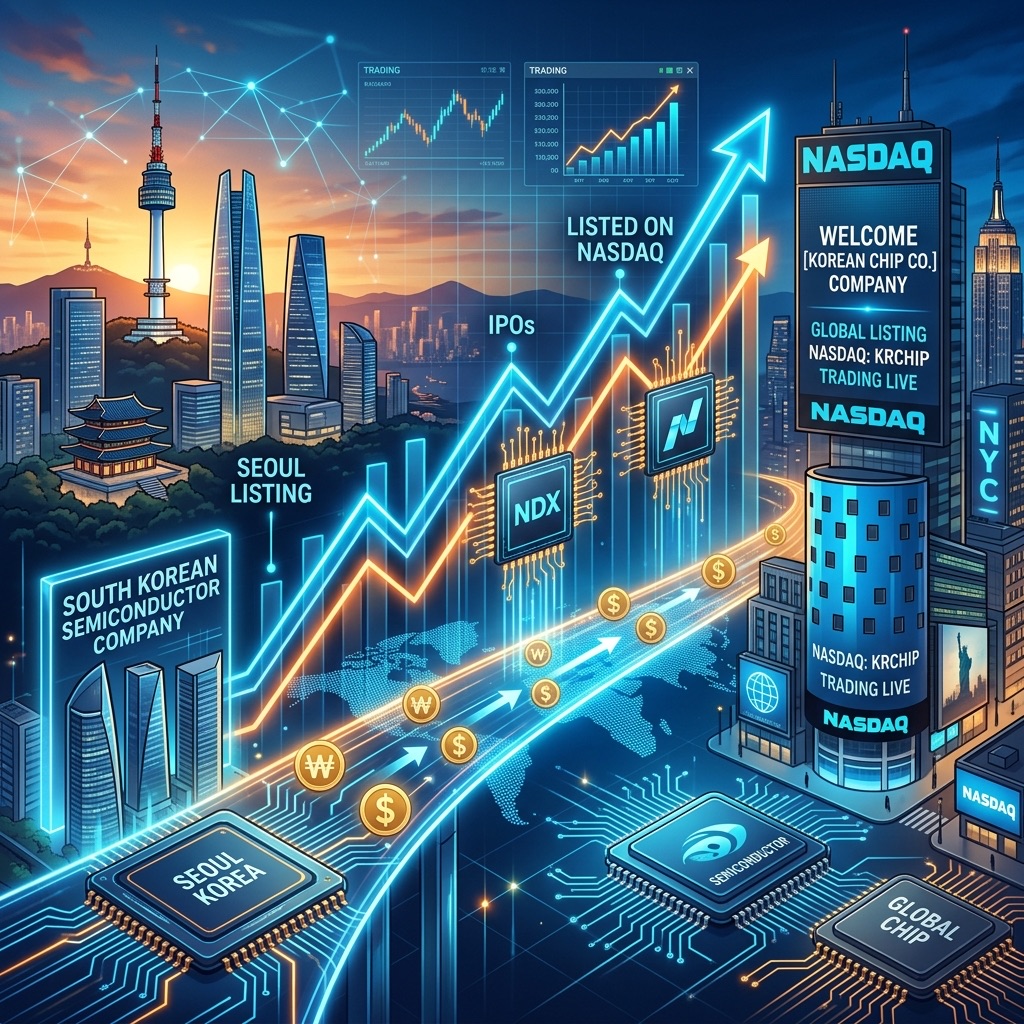
SK hynix is listing a new ADR on Nasdaq in the US. The Korean shares (on the Kospi) stay as they are, and the company adds a second venue where the stock trades in the US. Think of an ADR as a receipt that lets US investors buy and sell a foreign company's shares in dollars.
This piece lays out, from a brokerage analyst's view, what the ADR listing means for the stock. Difficult terms are explained inline, estimates are flagged as estimates, and unconfirmed items as unconfirmed. It is a map for understanding the structure, not a recommendation.
Three conclusions up front
- The local (Korean) shares rise too. US demand reaches the local shares through an arbitrage channel. The closest analog, TSMC, actually saw its local shares (+50%) outrun the US ADR (under +40%) in 2026. Korea's local shares are likely to capture most of the rerating.
- Korean retail is almost always better off buying at home. The decisive reason is taxes: tax-free locally versus 22% on US stock.
- It is a double-edged sword. As much as there is hope for a US-chip-style rerating, there is also the burden of new-share dilution, profit-taking after a big run, and deeper chip concentration.
Current position and price target (as of 2026-06-22)
- Current price
- About 2.92 million won (all-time high, near '3-million hynix')
- Market cap
- About 2,080 trillion won, retook the Kospi #1 spot past Samsung
- Valuation
- 12M forward PER 6-7x vs Micron 10x vs US chip index 27x
- Brokerage targets
- 3.5-4.3M won (center) / 5M max (Nomura)
- Past 1-year move
- About +280%
What is happening right now
The company's official line is still "size, timing, and price are undecided," but the SEC filing and brokerage and press reporting converge on the following.
| Item | Detail |
|---|---|
| Stage | F-1 filed confidentially with the SEC on Mar 24, overseas roadshow done, SEC review result expected late June |
| Timing | Nasdaq debut as early as July, August at the latest |
| Structure | New-share issuance. Newly printed shares sold to US investors (to raise capital) |
| Size | About 2.5% of shares (about 17.8M shares), proceeds estimated 14 to 27 billion dollars, wide range |
| Bookrunners | Citi, JPMorgan, Goldman Sachs, BofA |
| Defenses | 2.1% treasury-share cancellation (about 12T won) plus a roughly 66 billion dollar shareholder-return target |
| Use of proceeds | HBM expansion, the Yongin chip cluster (about 600T won), the US Indiana plant |
In plain terms: SK hynix raises money in the US by printing new shares (issuance, which slightly dilutes existing holders as share count rises), and on the other side burns its existing treasury shares (cancellation, which raises each holder's stake as share count falls), trying to offset the two effects. At the same time it promises over 66 billion dollars in shareholder returns to soften the "dilution" criticism in advance.
Why the ADR and the Korean shares move as one body
This is the most confusing part. The bottom line: the ADR price is roughly the Korean price times FX, because the ADR and the local shares are convertible.
If the US ADR gets more expensive than the Korean shares, an arbitrageur, a trader who profits on price gaps, does this: buy the cheap Korean shares, deposit them and convert to ADRs, and sell in the expensive US. That adds buying to the local shares (Korean price up) and selling to the ADR (ADR down), and the two prices usually re-converge within days.
Two key points follow. First, the listing itself does not directly lift the Korean price. What the listing creates is new US demand, and that demand lifts the local shares through the arbitrage channel. Second, SK hynix is a won company, so buying the ADR still leaves you with the Korean price times FX, meaning no dollar diversification. That point is central to the local-versus-US comparison below.
TSMC as a mirror: "US listing means the local shares don't rise" is wrong
To see what SK hynix is hoping for, look at TSMC (Taiwan's chipmaker, the world's #1 foundry). TSMC has long been dual-listed on the Taiwan exchange and as a US ADR, and it walked the same road first amid the AI boom.
TSMC showed two things. One, the US premium is real but not eternal. TSMC's US ADR long traded about 20% above the Taiwan shares. Two, in 2026 the local shares overtook the ADR. That is the crucial part.
| Time | ADR premium | What happened |
|---|---|---|
| Dec 2025 | About 26% | The US ADR was 26% more expensive than the Taiwan shares |
| May 2026 | About 13.7% | Narrowed for five straight months as the local shares rose faster |
In 2026 the Taiwan local shares rose over +50% and the US ADR under +40%. The local shares won. The reason: in late April 2026 Taiwan's regulator lifted the single-stock cap for domestic funds from 10% to 25%, and local money piled into TSMC. Taiwanese retail and institutions believed in the AI supercycle even more strongly than foreigners and bought the local shares.
Here is the part Korean investors will like. The real reason TSMC's US premium was large is that Taiwan blocks conversion between local shares and ADRs by regulation. With conversion blocked, US demand could not flow to the local shares and pooled in the ADR, creating the premium. Korea is different.
| Comparison | TSMC (Taiwan) | SK hynix (Korea) |
|---|---|---|
| Local share to ADR conversion | Restricted (special approval needed) | Relatively free |
| Foreign ownership cap | Historically constrained | No cap |
| Result | US demand pools in the ADR, large premium | Arbitrage fills the premium quickly |
With free conversion, US rerating demand passes straight to the Korean shares. Those already holding the Korean stock capture most of the rerating. The sober flip side: the SK hynix ADR is unlikely to hold a 20%+ premium for long, because arbitrage shaves it off fast. The "unreachable premium gap" is smaller than TSMC's, which also means the Korean shares lose less.
The TSMC lesson is clear. "US listing means only the ADR rises and the local shares don't" is wrong. If anything, in 2026 TSMC's local shares rose more, and Korea, with freer conversion, is set up for an even larger effect.
Price path by stage
There is a timing risk, though. The expected window (July-August) overlaps with the National Pension rebalancing restart, the US rate decision (FOMC), and the tariff ceasefire expiry. Even a good event can turn volatile if it lands while the whole market is swinging.
Where will the local share price settle?
The part most people want to know. In analyst fashion, three pillars build the range.
Pillar 1. Bigger earnings, but a quarter of the multiple. SK hynix already passed Micron on market cap, but because its earnings are bigger, its PER is still far below Micron (10x) and the US chip index (27x).
| Metric | SK hynix | Micron (US) |
|---|---|---|
| Market cap | About 1.4 trillion dollars (about 2,080T won) | About 1.18 trillion dollars |
| 12M forward PER | About 6-7x | About 10x |
| HBM market share | About 57% (#1) | About 21% |
| Nvidia next-gen (Rubin) HBM4 supply est. | About 60-70% | The rest |
The stock is not expensive; the earnings are simply that large. The ADR listing's aim is precisely to close this multiple gap. A rerating from 6-7x just to Micron's 9-10x implies about +40 to +50%, and more if US ETF inclusion and rerating progress further.
Pillar 2. Brokerage targets. KB and SK Securities 3M won, iM Securities 3.5M, Goldman Sachs 3.3-3.5M, Hanwha Investment 4.3M (highest at home), Nomura up to 5M. The center is 3.5 to 4.3 million won.
Pillar 3. The TSMC precedent. TSMC's local shares rose +50% in 2026 alone, overtaking the ADR. With freer conversion, Korea's local shares are set up to absorb the rerating more fully, so those targets are more likely to be realized in the Korean shares than the ADR.
Putting it together, the 12-month scenario:
| Scenario | Price band | Premise | vs current (2.92M) |
|---|---|---|---|
| Bull | 4.5-5M won | AI supercycle continues + hot listing + double-digit PER rerating + ETF inclusion | +55-70% |
| Base | 3.5-4.3M won | Multiple gap narrows toward Micron, decent US demand | +20-47% |
| Bear | 2-2.5M won | AI overheating + memory slowdown (2027+) + post-listing profit-taking/dilution | -15 to -30% |
If things go smoothly, 3.5 to 4.3 million (local shares); if the AI boom runs strong, 5 million comes into view. But this stock already roughly tripled in a year, so if AI enthusiasm cools or sell-the-news hits, a pullback to the 2 million range is entirely possible. The upside is large but so is the volatility.
Local vs US: where should Korean retail buy?
Since it is the same SK hynix, returns are effectively identical via arbitrage. The difference comes down to taxes, FX, and costs, and the conclusion is that Korean retail is almost always better off locally. The clincher is taxes.
| Item | Local (Korean shares) | US (ADR) |
|---|---|---|
| Capital gains tax | Tax-free (small shareholders, no financial-investment tax) | 22% (after 2.5M won deduction, 20% + 2% local tax) |
| FX | Done in won, no conversion | Won to dollar to won, two conversions (fees) |
| Trading cost | Low commission | US commission + ADR custody fee + FX cost |
| Trading hours | Korean day | US night, can react instantly to overnight AI news (the US route's only real edge) |
In numbers it is clear. Assume a 10 million won gain: the local market is zero tax and the US ADR is about 1.65 million. The math is (10M - 2.5M) x 22% = 1.65M. That gap alone ends the game. There is also no FX diversification: SK hynix is a won company, so the ADR is still Korean price times FX, with no benefit of holding a dollar asset (you would need a true US company like Apple for a dollar hedge).
The US route is marginally better only for dollar-based overseas residents, those who must react in real time during US hours, and the early period when the ADR temporarily trades cheaper than the Korean shares.
Risk: what to worry about and how much
As said, it is a double-edged sword. Starting with the most fundamental risk, honestly laid out.
Key risk priority
- 1 Memory downcycle
- Severity very high / probability medium (the core risk)
- 2 Front-running, sell-the-news
- Severity high / probability medium (biggest near-term risk)
- 3 AI bubble, US volatility spillover
- Severity high / probability medium
- 4 Chip concentration, US sync
- Severity high / probability high
- 5 Listing failure, delay, downsizing
- Severity high / probability medium
A memory downcycle is the single most fundamental risk. Essentially all of SK hynix's profit hinges on memory prices. Now is a record boom with a 72% operating margin in Q1, but memory is a cyclical industry: heavy boom-time buildout causes an oversupply price crash two to three years later. In the last downcycle (2018 to 2019), operating profit fell from about 20.8 trillion to 2.7 trillion (-87%) and the stock dropped about 40 to 50% from its peak. The near term (2026) is relatively safe, with 2-3 weeks of inventory and multi-year sold-out contracts, but the real danger window is mid-2027 to 2028 as new fabs ramp. Since the ADR proceeds accelerate that buildout, there is a sense in which it pulls the oversupply risk forward.
Front-running and sell-the-news are scariest in the near term. Much of the +280% run to the #1 market-cap spot rests on ADR-listing hope. Once a catalyst is fully known and priced in, the moment the listing becomes reality can bring sell-the-news profit-taking. That said, with free conversion, the counterforce of US rerating demand lifting the local shares also works, so there is no need to lean to a one-sided down narrative.
Exaggerated fears should be cleared away. For accurate judgment, here are corrections to fears that do not match the facts.
| Rumor | Fact |
|---|---|
| Up 8x in a year | Actually about +280% (about 3x). Steep, yes, but not 8x |
| 90% of revenue depends on Nvidia | Actually 15-25%. The 90% is a misread of SK's share of the HBM Nvidia uses |
| The ADR creates new volatility | The sync already existed; the ADR only accelerates price discovery into the night |
| Dilution is large | It is small at 2.5%, and treasury cancellation and rerating offset much of it |
| It's an ADR, so a premium | Korea's free conversion can mean a discount instead. The opposite of TSMC |
Other risks to note: listing failure or delay (the company says nothing is confirmed, so the hope could reverse), US tariffs (memory is currently duty-free but a second round is signaled, and the Indiana plant is packaging-only so its exemption eligibility is uncertain), HBM4 multi-vendor competition (Nvidia certified Samsung and Micron too, so the monopoly premium derates toward an oligopoly valuation), and the discount peculiar to Korean ADRs (past Korean ADRs often traded below the local shares, the opposite of TSMC).
Risk in one line: scariest near term is front-running and concentration volatility (sell-the-news); most fundamental medium term is the 2027-2028 memory downcycle. The rest (dilution, flows, taxes, FX) are mostly manageable secondary risks.
Will it affect the Kospi index?
Structurally the effect is small. SK hynix does not leave the Kospi; it stays, and the new shares are sold to US investors as fresh money, so they do not drain Korean market capital. But through the price channel the effect is large. SK hynix is about 7% of the Kospi, and with Samsung the two chips are over half the index. If the ADR lifts the local shares, the Kospi rises; if the local shares fall on profit-taking, the Kospi falls.
In one line, it is not "the ADR makes the index move on its own" but "if the ADR moves the SK hynix price, that is the Kospi." The full Kospi picture, with 56% chip concentration and 38 trillion in margin debt, is covered separately in Kospi hit 9,000 while foreigners dumped over 100 trillion.
Monitoring checklist
- SEC final approval, pricing, and confirmed new-share size (dilution). A failure or delay reverses the hope.
- US roadshow demand. Stronger demand is a positive for the local shares.
- The post-listing ADR-to-local premium or discount. A discount signals a missing rerating.
- US chip ETF (SOXX and others) inclusion. Passive buying.
- Memory cycle signals. DRAM/HBM contract prices, inventory weeks, the 2027 new-fab ramp schedule.
- Competitive landscape. Samsung and Micron penetration of Nvidia HBM4 volume, SK's share trend.
Disclaimer
This piece is analysis and educational information compiled and cross-checked from public reporting and brokerage research, not investment advice to buy or sell any security. Figures are as of the writing date (June 22, 2026) and change frequently. The final offering size and per-share price, SEC approval and confirmed listing date, and US ETF inclusion are unconfirmed, and price targets, valuations, and shares are quotes from brokerage reports and press at the time of writing. Scenario probabilities and price bands are subjective estimates based on precedent and mechanism. All investment decisions and their outcomes are the investor's own responsibility.
References
- SK hynix ADR, Nasdaq as early as July (Invest Chosun)
- SK hynix ADR as early as July/August, SEC approval late June (The Elec)
- SK hynix ADR listing, $14B, 2.5% (Yahoo/Reuters)
- SK hynix ADR in August, $15B raise, SOXX inflow (Douglas Research)
- SK hynix target 3.5M won, Q2 operating profit 63.7T (Newspim/iM)
- SK hynix target 4.3M won, highest at home (Hanwha Investment)
- TSMC ADR premium 26% to 13.7%, local overtakes (Whalesbook)
- TSMC ADR premium at a two-year low (Yahoo Finance)
- Micron vs SK hynix valuation and HBM share (Benzinga)
- SK hynix new-share ADR structure (Hankyung)
- Korean ADR history and Doidge et al. (2004) cross-listing study (NBER w8538)