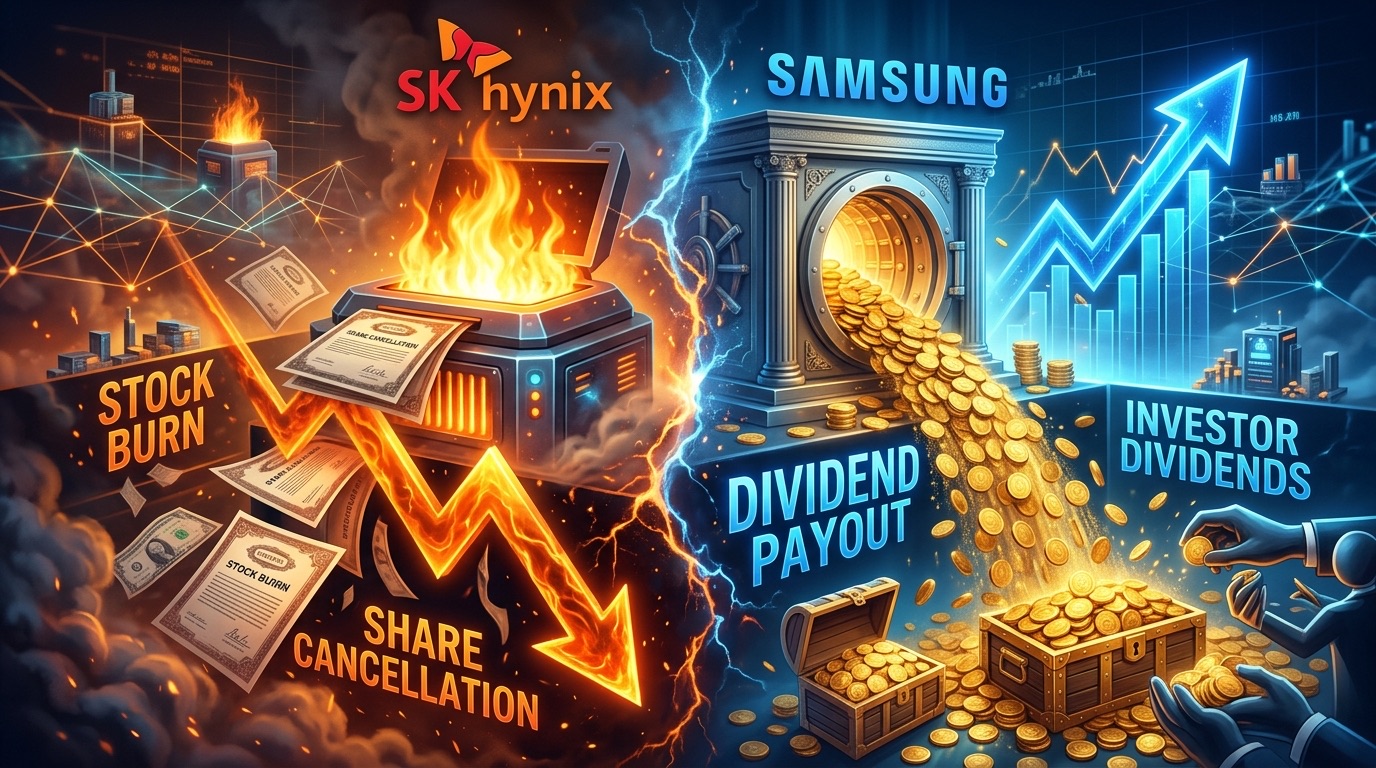
In the second half of the third week of August 2026, Korea's two largest companies announced record shareholder returns two days apart. On size alone, Samsung Electronics was far bigger. The share prices moved the other way. This piece walks through what happened over those two days and why the side that called the bigger number lost, measured against price and flow data from August 3 to 21. The tax thread continues from Korea's High-Dividend Separate Taxation, and the Hynix new-share issuance from SK Hynix ADR: Can It Reach 5 Million Won?. Jargon is explained inline, with a glossary at the bottom.
Two Announcements in One Week
It started with a synchronized crash on August 19. A vessel was struck in the Strait of Hormuz and explosions were reported at Isfahan airport in Iran, putting Middle East geopolitical risk back on the table, and that landed on top of an overnight selloff in New York tech and rising US Treasury yields. A sell-side sidecar fired on the KOSPI early in the session. SK Hynix closed down 9.75% at 1.5 million won and Samsung Electronics down 7.82% at 247,500 won. Foreigners sold 1.2 million Hynix shares and 4.18 million Samsung shares net.
After the close that same day, the SK Hynix board approved a 40.0043 trillion won buyback and cancellation.
SK Hynix Cancellation (Aug 19 board)
- Amount
- 40.0043 trillion won
- Shares
- 24.07M (3.3% of shares outstanding)
- Purchase window
- 2026-08-20 to 11-19, on-market
- Cancellation
- Entire block within 1 to 2 weeks of completion
- Return target
- Raised from 50% of 2025-2027 cumulative FCF to 50% or more
It is the largest share cancellation by a Korean listed company on record. The line worth staring at is the last one. The payout target, previously capped at 50% of free cash flow, was revised upward to 50% or more in this same announcement. That single line does a lot of work later, when we test the bear case.
Two days later, after the close on August 21, the Samsung Electronics board approved a 2026 shareholder-return program of 90 to 110 trillion won. That is more than five times the 20.3 trillion won of 2020 and the largest in the company's history.
Samsung Shareholder Returns (Aug 21 board)
- Headline size
- 90 to 110 trillion won (2026)
- Fixed now
- Q3 cash dividend about 30T won + 15T won buyback for employee compensation
- Dividend per share
- To be set at the late-October board (undecided)
- Remaining 60 to 80T won
- Cash or cancellation, deferred to the January 2027 board
This is the fork in the road. The Hynix filing let you reach for a calculator the moment you read it. The Samsung filing had a large headline number and an empty space where the what, when, and how should have been.
What the Prices Actually Did
| Date | SK Hynix | Samsung Electronics | Samsung pref. | Event |
|---|---|---|---|---|
| 08-18 | 1,662,000 | 268,500 | 188,300 | (nothing notable) |
| 08-19 | 1,500,000 (-9.75%) | 247,500 (-7.82%) | 173,700 (-7.75%) | Middle East shock, sidecar / after close, Hynix 40T cancellation filed |
| 08-20 | 1,691,000 (+12.73%) | 271,000 (+9.49%) | 191,200 (+10.08%) | Hynix cancellation priced in / Samsung "100T won" scoop |
| 08-21 | 1,730,000 (+2.31%) | 281,500 (+3.87%) | 207,000 (+8.26%) | Foreign wires flag an announcement intraday / after close, Samsung 110T approved |
| 08-21 after hours | (no trades) | 269,500 | (no trades) | Reversed lower right after the release |
The sequence matters. Samsung gave back its gain in the after-hours market, not the regular session. In the regular session it finished 3.87% higher at 281,500 won, with an intraday high of 285,000 won. Once the plan was published after the close, it slid to 269,500 won in after-hours trading: 4.26% below the regular-session close and 0.55% below the prior day's 271,000 won. The entire day's gain went out in one release, and then some.
SK Hynix did the opposite. From the August 19 crash close it rose 15.33% over two sessions and kept going the day after the announcement, up another 2.31%. There was no giveback.
One more contrast is worth flagging. While Samsung common gained 3.87% on August 21, Samsung preferred jumped 8.26% on 10.35 million shares, 2.8 times the prior day's 3.72 million. The market translated Samsung's announcement as good news for the preferred, not the common. More on that below.
The Bigger Number Lost
Scale both packages to market cap and the oddity stands out.
Samsung's program is nearly twice as large, and yet Hynix gained 15% while Samsung netted nothing. The bigger number lost, which means size is not what set the price. So what did?
Four Reasons the Reactions Split
One: Certainty
The Hynix filing contains no open variables. Amount 40.0043 trillion won, quantity 24.07 million shares, ratio 3.3%, window August 20 to November 19, method on-market purchase, cancellation within one to two weeks of completion. Every input an investor needs is filled in. The board resolution is itself the execution schedule.
Samsung fixed exactly one number: the 30 trillion won total. The per-share dividend slips to late October, and the form of the remaining 60 to 80 trillion won slips to January 2027. Scaled to market cap, the confirmed portion is only 1.66%, while 3.31 to 4.42% will not take a known shape for five months. Out of a "up to 110 trillion won" headline, less than a third could be priced without a discount. That is precisely what Korean brokerages flagged: without a stated cancellation amount and execution schedule, the announcement failed to clear the bar.
Two: It Was Already Priced
The Hynix cancellation landed after the close on a day the stock fell 9.75%. Nothing leaked in advance, and nobody had modeled that size. Management effectively declared that at this price the company itself is a buyer, at the exact moment the market was afraid. As signals go, that is about as strong as it gets.
Samsung's 100 trillion won program surfaced first in a Korean exclusive on August 20, and on August 21 foreign wires reported intraday that the announcement was coming that day, which extended the rally. The 13.74% move from the August 19 low to the August 21 regular-session close was the market buying the announcement in advance. When the lid came off, the package was smaller than the roughly 150 trillion won the Street had floated, and all that was left was profit-taking. The after-hours drop reads less like disappointment and more like settling up on what had already been priced.
Three: A Dividend and a Cancellation Deliver Different Amounts
This is the most commonly misread part. You cannot line up "30 trillion in dividends" against "40 trillion in cancellation" at face value.
Start with the fact that a dividend comes straight out of the share price. Samsung's dividend-eligible share count can be backed out of the second-quarter filing.
Divide 30 trillion won by that and you get roughly 4,569 won per share, 12.2 times the 374 won regular quarterly dividend. On the ex-date, the share price is marked down by that amount. A dividend does not lift the share price; it moves value that was sitting inside the price into cash. The only channel by which a dividend announcement can lift a stock is the signal that this level of payout will continue, and Samsung offered no policy beyond 2027.
On top of that, dividends are taxed and cancellations are not. That asymmetry is larger than most people assume.
Start with foreign holders. Korean-source dividend income is withheld at 22% under domestic law (20% income or corporate tax plus 2% local surtax). Under a tax treaty, that is usually capped at 15%, as with the US and Japan treaties. Capital gains created by a cancellation, by contrast, are largely untaxed: on-market disposals by portfolio holders below the 25% threshold are outside the domestic capital-gains net, and most treaties assign taxing rights on securities gains to the residence country.
And a large share of foreign holders never recover that 15%. A taxable fund can offset it at home through a foreign tax credit, but many of the largest global holders are tax-exempt entities: overseas pension funds, university endowments, sovereign wealth funds. With no domestic tax to offset, the 15% withheld is a permanent loss. The real mechanism behind "foreigners like dividends less" is not the rate; it is that irrecoverability.
Domestic investors sit on the other side. Corporates exclude a large portion of dividends received from taxable income, and from 2026 individuals can elect separate taxation on high-dividend companies (14% up to 20 million won, 20% up to 300 million, 25% up to 5 billion, 30% above), a sharp reduction from the 49.5% top comprehensive rate. Public funds are effectively exempt.
Run a rough estimate. Applying only the 15% treaty rate to the share-weighted foreign ownership of dividend-eligible stock (46.86% of the common and 76.70% of the preferred, weighting by share count, gives 50.46%) removes about 2.3 trillion won in withholding. Add the domestic slice and the 30 trillion won dividend delivers something closer to 26 trillion won to shareholders. The 40 trillion won cancellation, by contrast, transfers in full and untaxed into the value of the remaining shares. A good chunk of the headline gap erases itself right here.
Then there are two effects only a cancellation produces.
First, EPS rises. Retiring 3.31% of the float permanently lifts earnings per share by 3.42%. Consensus EPS of 349,566 won becomes roughly 361,500 won, and the estimated P/E on the August 21 close falls from 4.95x to 4.78x on its own. The valuation gets cheaper without the company earning another won.
Second, a real buyer sits in the market for three months. Hynix will buy 40 trillion won on-market over roughly 62 trading days, an average of 645.2 billion won a day. Hynix traded an estimated 7.3 trillion won a day on KRX between August 11 and 21 (volume times a representative price), so a buyer absorbing about 9% of daily turnover is present every session until November 19. A dividend does nothing of the kind. If anything, supply comes out around the ex-date.
Four: The Two Companies Never Had the Same Menu
The first three explain the outcome. The cause sits in ownership structure. Samsung Electronics is a company that cannot cancel shares at scale even if it wants to, and SK Hynix is a company whose controlling shareholder gains the more it cancels.
| Samsung Electronics | SK Hynix | |
|---|---|---|
| Binding rule | Financial Industry Structural Improvement Act art. 24: group financial affiliates must hold under 10% of another company | Fair Trade Act holding-company test: the holding company must keep 20% or more of a listed subsidiary |
| Current stake | Samsung Life 8.51% + Samsung Fire 1.49% = about 10% combined (room effectively used up) | SK Square 20.00% (sitting exactly on the floor) |
| If shares are cancelled | Smaller denominator pushes financial affiliates over the cap automatically, a breach | Smaller denominator lifts SK Square to 20.68% automatically, creating headroom |
| Cost of avoiding it | Financial affiliates must keep selling down, which weakens the core link in the group's control structure | None. It even creates room to issue new ADR shares |
| Owner's direct stake | Lee Jae-yong 1.67%, Hong Ra-hee 1.25% and others, so dividends go to the owner family as cash directly | Chairman Chey Tae-won holds about 3,620 shares, so dividends must pass through SK Square |
The same action is a compliance risk on one side and compliance headroom on the other. That asymmetry effectively dictated the choice of method.
The fact that SK Square's stake sits exactly at the 20.00% floor is especially important. It used to be 20.5% and was diluted to 20.0% when Hynix issued 17.79 million new shares (2.5% of shares outstanding) for its ADR. That 2.5% issue size was itself reverse-engineered so as not to break the 20% line. For Hynix, cancelling shares is both a return of capital and a way of buying back holding-company compliance.
The mirror image is on the record. When Samsung Electronics moved to cancel 73.36 million common shares in the first half, Samsung Life pre-emptively sold about 6.24 million shares (1.2176 trillion won) and Samsung Fire about 1.09 million shares (212.7 billion won) in block trades, trimming before the cancellation lifted their stakes automatically. Every cancellation requires the group's financial affiliates to shed more Samsung Electronics stock. Samsung's choice of dividends was not a preference; it was the optimum under the constraint that cash dividends do not move ownership percentages.
One footnote. The 15 trillion won of buybacks for employee compensation in Samsung's announcement will not be cancelled. The revised Commercial Act that took effect on March 6, 2026 makes cancellation within one year of acquisition the default rule, but allows exceptions for employee compensation and business purposes subject to shareholder approval. Samsung's 15 trillion won is exactly that exception. It temporarily reduces the float, but it is not a permanent transfer of value, and the shares return to the float once they are delivered to employees. That is why the market did not count it as a return.
An Aside: Who Is Asking for Cancellations?
The same split shows up in what shareholders demand. In this case minority shareholders pushed the so-called Meritz prescription, buy 45 trillion won of stock instead of paying dividends, and the Act corporate-governance institute asked for a payout ratio up to 100% of free cash flow with buybacks and cancellations prioritized over cash dividends. Korean activist funds, including KCGI in the DB HiTek case, have pressed consistently for cancellations.
Three reasons. There is no tax, cancellation automatically raises the stake of shareholders who did not sell and therefore their influence, and dividends hand the same cash to the controlling shareholder too. On the other side, the constituencies that prefer dividends are controlling families (who need cash for inheritance tax), holding companies (Hynix dividends are a primary cash source for SK Square), dividend funds and ETFs, and insurers and retirees who need the cash flow.
The Preferred Share Gave the Answer
Samsung preferred rising more than twice as much as the common on August 21 is the cleanest read on how the market interpreted the news.
A dividend pays effectively the same amount per share on the common and the preferred (374 won on both in the second quarter). But the preferred trades 26 to 30% cheaper. Identical cash on a 30% lower cost base means a proportionally higher yield.
What 4,569 Won per Share Yields
- Common (at 281,500 won)
- 1.62%
- Preferred (at 207,000 won)
- 2.21%
- Aug 21 reaction
- Common +3.87% / Preferred +8.26%
- Preferred volume
- 10.35M shares, 2.8x the prior day's 3.72M
So the moment Samsung's announcement reads as dividend-centric, the value flows automatically to the preferred. Had the market read it as a large cancellation, the opposite would have happened, because a cancellation lifts the value of voting common stock and moves the control structure.
The discount tells the same story numerically. The common-to-preferred discount, 29.45% on August 20, narrowed to 26.47% on regular-session closes and to 23.19% measured against the after-hours common price. The three-year average is 18%, so there is still room to compress as long as the dividend policy holds.
One caveat on the flow data, though. That day institutions bought 882,114 preferred shares net while foreigners sold 497,030 net, and foreigners bought 1,567,349 common shares net. The direction lines up neatly with the tax structure above. But foreigners have been selling the preferred and buying the common all month: from August 3 to 21, 2.29 million preferred shares sold net (net sellers on 10 of 14 sessions) against 4.95 million common shares bought net. The August 21 preferred selling is a continuation of that flow, not a new reaction to the announcement.
That the tax structure is real and that it produced that day's flow are two different claims. A single day of flow data cannot establish causation. The accurate statement is that the month's direction does not contradict the structure.
The Calendars Collide in Late October and November
August 22 was a Saturday, so the regular market has not delivered its final verdict on Samsung yet. The first checkpoint is whether the after-hours 269,500 won holds in the regular session on Monday, August 24.
For the dividend schedule, just follow last quarter. Samsung's second-quarter dividend had a June 30 record date, a July 30 board resolution, and an August 28 payment. Korea's 2024 Capital Markets Act amendment removed the rule fixing quarterly record dates to the end of March, June, and September, letting boards set the record date after fixing the amount, but Samsung still uses the quarter-end record date. If the third quarter follows the same pattern:
| When | Samsung Electronics | SK Hynix |
|---|---|---|
| 8/20 to 11/19 | (not applicable) | 40T won on-market buying underway (645.2B won a day) |
| Sep 28 (Mon) | Last cum-dividend buying day (Sep 30 record date, T+2) | (not applicable) |
| Sep 29 (Tue) | Ex-dividend, about 4,569 won marked off | (not applicable) |
| Late October | Board fixes the per-share amount and regular/special split of the 30T won | Q3 results plus a promised additional dividend plan |
| Nov 19 (Thu) | (not applicable) | Purchases end, full cancellation within 1 to 2 weeks |
| Late November | Q3 dividend paid (about record date +59 days on Q2's pattern) | Cancellation executed |
| January 2027 | Board decides the form of the remaining 60 to 80T won | (not applicable) |
Two things stand out. First, investors have to buy by September 28 without knowing the dividend per share, since the amount is only fixed in late October. The 30 trillion won total is public, so backing out roughly 4,500 won per share is possible, which makes it less than a complete blind. Second, the Hynix third-quarter results (late October) come before the end of the buyback (November 19), and the additional dividend plan is due at that event. That ordering is the crux of the next section.
Testing the Thesis: Hynix Short Term, Samsung Long Term
Here is the thesis to test.
The Thesis Under Test
- Samsung Electronics
- Money is far off, so it lags near term, but it rallies as the dividend record date approaches
- SK Hynix
- It buys stock immediately so it rallies near term, then falls when the event ends with nothing more behind it
- Conclusion
- Hynix for the short term, Samsung for the long term
The mechanics are broadly right. But one premise is factually wrong, and two different time horizons have been blended together.
What Holds Up
Samsung's near-term decline is already underway. Anticipation alone priced in 13.74%, and the announcement gave back a full day of it on release. With only 1.66% of market cap confirmed and the rest pushed out five months, a giveback after the catalyst is the natural path.
The case for Hynix near-term strength is real too. Until November 19, a buyer takes down 645.2 billion won a day, about 9% of average KRX turnover. That is disclosed execution, not expectation.
The instinct that the end of the buyback equals the end of that bid is also correct, and attaching a November 19 end date to the trade in advance is the right discipline. If you enter on an event, you exit when the event ends.
The Wrong Premise: 40 Trillion Is the Start, Not the End
"There is nothing more after this" does not match the facts. Hynix has committed to returning 50% or more of cumulative free cash flow for 2025 to 2027, and this very announcement raised the language from "50%" to "50% or more." Put the 40 trillion won next to the Street's cumulative return forecasts and its place becomes clear.
| House | Cumulative shareholder returns | Period | 40T won as a share |
|---|---|---|---|
| Goldman Sachs | 126T won (50% of 252T cumulative FCF) | 2025-2027 | 32% |
| Samsung Securities | 220T won | 2025-2027 | 18% |
| Nomura | 237T won (78T + 159T) | 2026-2027 | 17% |
| Hanwha Investment | 245T won | 2025-2027 | 16% |
One caution here. The FCF estimates themselves vary enormously. Goldman models 252 trillion won of cumulative three-year FCF while Hanwha models 491 trillion won (28.8T in 2025, 191.6T in 2026, 270.6T in 2027), nearly double. That is why the table above uses each house's own stated return total rather than an FCF figure. Even with that spread, the conclusion holds on the most conservative forecast: 40 trillion won is less than a third of the promised total.
Hanwha Investment analyst Park Jun-young argued that using even half the estimated return capacity for buybacks and cancellations could exceed 120 trillion won. That is why the Street is floating headlines like "245 trillion over three years, will cancellations top 100 trillion?" The company itself said it will disclose an additional dividend plan at its third-quarter results, and left further buybacks, cancellations, and special dividends open for consideration.
On the calendar, that disclosure (late October) arrives before the purchases end (November 19). What you are likely to face on November 19 is not an expired event but an event that has already been refreshed. The refresh may of course disappoint, but that is a fact to verify in late October, not a premise to assume away now.
The fix is straightforward. Stay long Hynix near term, but move the exit trigger from a calendar date to a condition: the content of the late-October additional return plan. If more cancellations come, the end of the buyback is not a reason to fall. If it is dividends only, or the size disappoints, that is the real exit.
The Blended Horizon: Samsung's Dividend Rally Is Five Weeks, Not Long Term
There is a basis for the observation that dividend-seeking buyers show up as the record date approaches. Roughly 4,569 won per share, 1.62% on the common and 2.21% on the preferred, is a meaningful size for a single quarterly dividend, and Korean income funds will move for it.
The problem is that on September 29 that 4,569 won is marked straight off the price. A dividend does not create value; it moves it. The rally into the record date is a round trip that gets reversed on the ex-date, and net of tax it is a loss. In other words, this path is a five-week trade that ends on September 28, not a long-term argument.
If that is so, the real case for "Samsung long term" has to be the January 2027 board and the form it gives the remaining 60 to 80 trillion won. And as shown above, that decision is bound by the 10% financial-holding rule. With Samsung Life at 8.51% and Samsung Fire at 1.49% having used up the room, a large cancellation requires the financial affiliates to keep selling, which means severing the group's core control link by its own hand. Structurally, dividends are likely to dominate again in January 2027. That is the weakest link in the thesis.
If the Dividend Case Is Right, the Instrument Is Different
There is no need to flip the thesis. But if the judgment that dividend-centric returns will continue is correct, the beneficiary is the preferred, not the common. The market already answered that way on August 21, and a 26.47% discount against a three-year average of 18% leaves room to compress. Expressing a dividend thesis through the common is a mismatch between the argument and the instrument.
Common to Both: Shareholder Returns Are Not the First-Order Variable Here
This is the most important caveat. Between August 3 and 21, the standard deviation of Hynix's daily returns was 6.16% (max +12.73%, min -10.37%) and Samsung's was 4.68% (max +9.49%, min -7.82%).
The Hynix cancellation is 3.17% of market cap. That is a little over half of one daily standard deviation, and a third of the single-day drop on August 19. What pulled the stock down 9.75% that day was the Strait of Hormuz and US Treasury yields, not shareholder returns. The same goes for the 1.66% represented by Samsung's 30 trillion won dividend.
Widen the lens and it is starker. From the September 2025 low, Samsung went from 67,500 won to 281,500 won, a 4.17x move, and SK Hynix from 255,000 won to 1.73 million won, 6.78x. What produced that was the memory cycle and AI demand, not capital returns. Even the fact that the yield on Samsung's second-quarter regular dividend fell to 0.1% is not because the dividend shrank; it is because the stock quadrupled.
So even if this thesis is right, the signal is smaller than the noise thrown off by the cycle, FX, and geopolitics. Being right on direction is compatible with getting shaken out along the way. If you are going to take a directional position on an event, size it against that volatility and set stops in standard deviations.
The Verdict
| Claim | Verdict | Basis |
|---|---|---|
| Samsung falls near term | Agree | 13.74% priced in before the release, only 1.66% of market cap confirmed |
| Hynix rises near term | Agree | 645.2B won a day of committed buying to 11/19, about 9% of KRX turnover |
| Nothing more from Hynix after this | Rejected | 40T is 16 to 32% of the promised total; additional plan due late October |
| Samsung rallies into the record date | Partly agree | A five-week trade to 9/28. The 4,569 won round-trips on the 9/29 ex-date |
| Samsung as the long-term pick | Weakly supported | The real variable is the January 2027 cancellation share, which the 10% rule constrains |
| The dividend beneficiary | Not the common | Measured on 8/21: preferred +8.26% versus common +3.87% |
Direction is broadly right, but the exit condition and the instrument need to change. Judge the Hynix exit on the content of the late-October plan rather than on the November 19 date, and express the Samsung dividend thesis through the preferred rather than the common. And for both positions, reflect in your sizing that a signal worth about 3% sits inside 6% daily volatility.
What This Leaves Behind
The price effect of a capital return is set by certainty and form, not size. A confirmed cancellation worth 3.17% of market cap beat an unconfirmed package worth 6.07%. Calling a big total is a negotiating tactic, not a catalyst. What to read in an announcement is not the headline number but by when, in what form, and executed by whom.
A dividend does not lift a share price. It moves what was already inside the price into cash, and shrinks it by the tax on the way. For a dividend announcement to lift a stock, it needs a promise of continuation rather than the dividend itself, and Samsung left everything after 2027 blank. A cancellation lifts per-share value permanently without tax, and creates real buying while the purchases run.
In events like this, the cause is usually the ownership structure. Samsung's choice of dividends was the output of the 10% financial-holding rule, not a management philosophy, and Hynix's choice of cancellation was not generosity but an alignment with SK Square's 20% requirement. Asking Samsung Electronics why it will not cancel shares is a question with a predetermined answer.
Check first whether the news was already priced. For identical content, whether it lands on the night of a crash or after a 13.74% two-day run decides half the reaction.
Where the Numbers Come From
The figures in this piece fall into three categories, and they should be cited differently.
Measured, quotable as is. Daily OHLCV and investor-type flows from August 3 to 21, market caps, consensus EPS and P/E, and the September 2025 monthly low. These were pulled directly from public market-data APIs. The price table above, the discount, foreign and institutional net buying, and the daily standard deviations (6.16% and 4.68%) belong here. One exception: the 269,500 won after-hours print is an NXT off-hours trade, which is a different animal from a KRX regular-session close. It is only confirmed once the regular session opens on Monday, August 24.
Filing and press based, sourced. Hynix's 40.0043 trillion won and 24.07 million shares and the August 20 to November 19 window; Samsung's 90 to 110 trillion won, the 30 trillion won third-quarter dividend, the 15 trillion won employee buyback, and the January 2027 board; Samsung's second-quarter dividend (June 30 record date, July 30 resolution, 374 won per share, 2,455,894,601,644 won total, August 28 payment); and the stakes (Samsung Life 8.51%, Samsung Fire 1.49%, Lee Jae-yong 1.67%, Hong Ra-hee 1.25%, SK Square 20.00%).
Calculated or estimated, assumptions attached. These move if the premises move.
| Figure | How it is derived | Where it can break |
|---|---|---|
| DPS 4,569 won | 30T ÷ 6,566,560,000 shares (backed out of the Q2 filing) | Buying the 15T won of employee stock before the record date shrinks the eligible count and raises the per-share figure |
| Withholding about 2.3T won | 30T × 50.46% share-weighted foreign ownership × 15% treaty rate | Non-treaty holders pay 22%, and foreign ownership shifts until the record date |
| Buying at about 9% of turnover | 645.2B ÷ 7.3T average daily KRX turnover (8/11-21, volume × representative price) | Turnover is an estimate. On a consolidated basis including NXT, the share falls by nearly half |
| About 62 trading days | 8/20 to 11/19, excluding Chuseok, National Foundation Day, Hangul Day | A snap public holiday moves it by a day or two |
| Record date 9/30, ex-date 9/29 | Assumes Samsung repeats Q2 mechanics (6/30 record date) plus T+2 | The 2024 Capital Markets Act amendment lets boards set the record date separately. Samsung still uses the old method, but a Q3 change shifts the whole schedule |
| Payment late November | Q2 pattern (record date +59 days) | A board decision |
| Hynix returns of 126 to 245T won | Broker forecasts as published | FCF estimates split two-to-one, from 252T to 491T. Read it as a range only |
Two weak links are worth naming. First, the September 30 record date rests on the assumption that Samsung repeats last quarter's mechanics, and the five-week trade argument hangs on it, so it has to be confirmed by the late-October board disclosure. Second, the spread in Hynix FCF estimates is a factor of two. The conclusion above holds even at the most conservative value, so the direction stands, but individual FCF figures should not be cited on their own.
Glossary
| Term | What it means |
|---|---|
| Buyback vs cancellation | A buyback is the company purchasing its own stock and holding it. A cancellation retires those shares, permanently reducing shares outstanding. Only cancellation actually raises per-share value. |
| Record date / cum-dividend / ex-dividend | You must be on the register on the record date to receive the dividend. With T+2 settlement that means buying by two business days earlier (the last cum-dividend day), and the next day the price is automatically marked down by the dividend (ex-dividend). |
| 10% financial-holding rule | Article 24 of Korea's Financial Industry Structural Improvement Act, which bars a group's financial affiliates from holding 10% or more of another company. Samsung Life and Samsung Fire are bound by it. |
| 20% holding-company rule | Under the Fair Trade Act, a holding company must keep at least 20% of a listed subsidiary. SK Square's 20.00% of Hynix sits exactly on that floor. |
| FCF (free cash flow) | Cash from operations minus capital expenditure, the money a company can deploy freely. It is the base for shareholder-return targets. |
| EPS / P/E | EPS is net income divided by share count. A cancellation shrinks the denominator, lifting EPS and mechanically lowering the P/E. |
| Common-preferred discount | The price gap between common and preferred shares as a percentage. When dividend appeal rises, the preferred moves first and the gap narrows. |
| Withholding / tax treaty | Tax deducted by the company before the dividend is paid. Korean domestic law says 22%, but treaty-eligible foreign holders are usually capped at 15%. |
| Dividends-received deduction | A rule excluding part of the dividends a corporation receives from taxable income, easing double taxation. |
| Block trade | Selling a large parcel of shares to institutions in one go after the close, used to limit market impact. |
| After-hours / NXT | Trading after the regular session closes. NXT is an alternative trading system, and its prints are not the same thing as a KRX regular-session close. |
| Sidecar | A circuit-breaker-style halt that suspends program trading for five minutes when futures move sharply. Its firing is itself a gauge of the shock. |
| Priced in / sell-on-news | Rising on expectation alone is priced in; falling on profit-taking once the news actually lands is sell-on-news. |
| Standard deviation (volatility) | How widely daily returns scatter around their mean. When an event's signal is smaller than this, it gets buried in noise. |
Disclaimer
This piece is research collected and cross-checked from public filings, reporting, and market data for informational purposes, and is not investment advice recommending the purchase, sale, or holding of any specific security. The companies mentioned (SK Hynix, Samsung Electronics, Samsung Electronics preferred, SK Square and others) are analytical examples, and the author may hold some of them. Prices and moves are as of the August 21, 2026 close and may differ slightly on an intraday or reporting basis. The 269,500 won after-hours print is an NXT off-hours trade and is not equivalent to a KRX regular-session close. Record dates, ex-dates, dividends per share, and total return forecasts are all estimates and can change by board decision. Tax rates and taxability depend on residence, holding structure, and treaty eligibility, so consult a professional for your actual tax position. All investing carries the risk of principal loss, and investment decisions and their consequences rest with the investor.
References
SK Hynix cancellation
- SK Hynix's large share cancellation: what it means for the market · Hankyung
- SK Hynix jumps 6% early after 40T won buyback and cancellation · Hankyung
- SK Hynix to buy 40T won of stock and cancel all of it, the largest by a Korean listed company · Financial News
- Cash to shareholders: SK Hynix's big call, and 40T is only the start · Hankyung
- SK Hynix seen returning 245T won over three years, will cancellations top 100T? · Daum News
Samsung shareholder returns
- Samsung Electronics: up to 110T won in returns, 30T cash dividend in Q3 · Hankyung
- Samsung's record 110T return leans on dividends over buybacks · MoneyToday
- Samsung announces up to 110T won in returns, so why did only the preferred jump 8%? · Hankyung
- Record returns, but the stock stalls: the news was already priced · Newspim
- Samsung Electronics Q2 dividend of 374 won per share, 2.4559T won total · ETNews
- Samsung AGM approves 16T won share cancellation · ZDNet Korea
Ownership structure and regulation
- Samsung pays dividends, SK cancels shares: why the methods differ · MoneyToday
- Samsung Life and Samsung Fire block-trade 1.4T won of Samsung stock ahead of the 10% rule · Newsquest
- The magic of 20%: how Hynix returns become record cash for SK Square · Newsquest
- SK Square gains from the Hynix ADR but must defend its 20% stake · Daum News
- Guide to the revised Commercial Act on mandatory share cancellation · Ministry of Justice (2026.3.11)
Shareholder demands and activism
- Buy 45T won of stock instead of paying dividends: the Meritz prescription for Samsung · Financial News
- Cancel the shares: the activist fund offensive · Asia Economy
Tax and dividend procedure
- Capital Markets Act amendment on dividend procedure and disclosure · Financial Services Commission
- 2026 separate taxation for high-dividend companies · Mirae Asset Securities
- Withholding on dividend income of non-residents and foreign corporations · National Tax Service
- Scope of capital gains tax on shares · National Tax Service
Market
Prices, flows, market caps, and dividend figures were cross-checked against daily bars and investor-type flow data from public market-data APIs (August 3 to 21, 2026) and the September 2025 monthly bar.