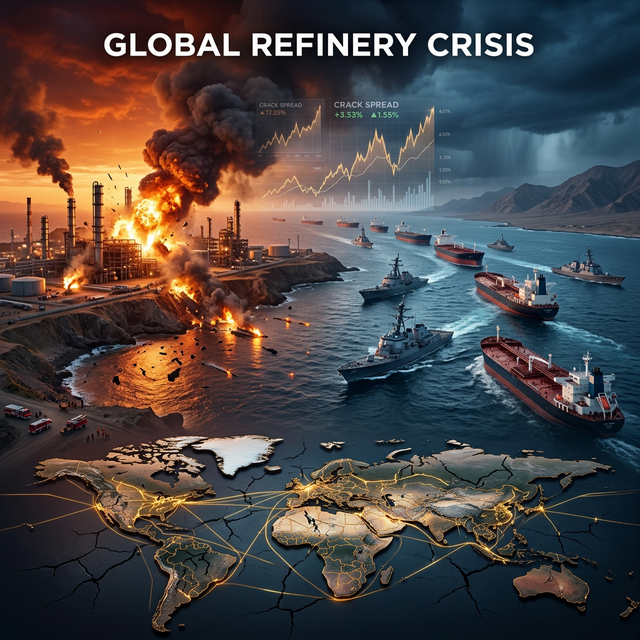
Crack Spread Hits $65 — Is It Too Late to Buy Refinery Stocks?
As of March 12, 2026 | Analysis of the dual crisis: Russian refinery drone strikes + Strait of Hormuz blockade
Introduction
Ukraine's sustained drone campaign against Russian refineries — underway since 2025 — has now collided with the de facto blockade of the Strait of Hormuz following US-Israeli strikes on Iran in late February 2026. The global refining industry faces a once-in-a-generation double shock.
With crude above $100/bbl and diesel crack spreads rocketing to $65/bbl, the central investment question is straightforward: who fills the gap left by destroyed refining capacity?
1. The Situation: Two Crises Hit at Once
Crisis #1: Russian Refinery Drone Strikes (2025–Present)
Ukrainian forces have struck 21 of Russia's 38 major refineries since early 2025. In November 2025 alone, they executed a record 14 attacks in a single month, extending their reach from western Russia (Ryazan, Saratov) all the way to Siberia (Tyumen).
| Metric | Figure |
|---|---|
| Refineries hit | 21 of 38 |
| Primary distillation capacity lost | Estimated 15–38% (wide range) |
| Actual output reduction | JPMorgan estimate: ~500,000 bbl/day (~10%) |
| Russian diesel exports | Down ~30% year-over-year |
| Recovery outlook | IEA expects output suppressed through mid-2026 |
Why recovery is so difficult:
- Western sanctions block precision equipment imports — Refineries require highly specialized components (distillation columns, catalytic crackers) that Russia cannot manufacture domestically
- "Repair it and we'll hit it again" strategy — Ukraine shifted from one-off strikes to sustained destabilization, re-targeting facilities as soon as they come back online
- Skilled labor flight — Workers are leaving hazardous refinery zones, with overseas emigration accelerating
- Insurance refusal — International insurers have stopped underwriting Russian refining assets
According to Carnegie Endowment analysis, full restoration of Russian refining capacity will take a minimum of 2–3 years.
Crisis #2: Strait of Hormuz Blockade (February 28, 2026–Present)
On February 28, 2026, a US-Israeli coalition struck Iranian nuclear facilities. Following the death of Supreme Leader Khamenei, the Islamic Revolutionary Guard Corps (IRGC) effectively blockaded the Strait of Hormuz in retaliation.
Why the Strait of Hormuz matters:
- Carries 20% of the world's seaborne crude oil (~20 million bbl/day)
- The sole export gateway for Saudi Arabia, UAE, Iraq, and Qatar
- Tanker traffic dropped ~70% before falling to near-zero
Cascading effects:
- Saudi Ras Tanura refinery operations suspended
- Two major Qatari LNG facilities shut down
- European natural gas futures surged ~30%
- Houthi rebels threatening renewed attacks on Red Sea shipping — further disrupting global trade routes
- IRGC statement: "Not a single liter of oil will pass through the Strait of Hormuz"
The Compounding Effect
Russian refinery destruction → Global refining capacity reduced
       +
Hormuz Strait blockade → Middle Eastern crude and product exports cut off
       =
Global petroleum product supply crisis + Historic refining margin surge
Key Indicators (as of March 12, 2026)
| Indicator | Level | Context |
|---|---|---|
| WTI Crude | $100+/bbl | Highest since 2022 |
| Diesel Crack Spread | $65/bbl | 78% of all-time high ($83), still rising |
| Wholesale Diesel | Up 53% in 7 days | Largest two-week surge on record |
| Singapore HSFO | Up 40%+ vs. pre-war | Asian bunker fuel market in panic |
2. Refining 101: Why Crack Spreads Are the Key Metric
A quick primer for those less familiar with the oil supply chain.
The petroleum industry has three segments:
- Upstream: Exploration and production — oil-producing nations, supermajors
- Midstream: Transportation and storage — pipelines, tankers
- Downstream: Refining and distribution — refiners
What's being destroyed right now is downstream infrastructure — the facilities that convert crude oil into gasoline, diesel, jet fuel, and other products.
The crack spread is simply the difference between what refined products sell for and what crude oil costs. It's the most direct measure of a refiner's profitability.
Crack Spread = Refined Product Price − Crude Oil Price

Crack Spread ↑ = Refiner profits ↑ (every barrel refined is highly profitable)
Crack Spread ↓ = Refiner profits ↓ (refining barely covers costs)
When refining capacity gets destroyed → product supply falls → product prices rise → surviving refiners see their margins explode
3. How Much Global Refining Capacity Has Been Lost?
| Cause | Estimated Loss (bbl/day) |
|---|---|
| Russian refinery drone strikes | ~500K to as much as 2M |
| Hormuz blockade → Middle East refinery shutdowns | ~4–6M |
| Post-COVID permanent refinery closures (US/global) | ~3.3M (global), 1.1M (US) |
| Recent US closures (Phillips 66 LA, Valero Benicia) | ~300–400K |
Refineries that shut down during COVID's demand collapse never reopened. Layer on the physical destruction in Russia and the Middle East, and global refining spare capacity is now critically thin.
4. Regional Winners: Whoever Can Refine Crude Wins
The formula behind every refining crisis is the same:
The biggest winners are those who can reliably source crude AND have operational refining capacity.
Here's how each region stacks up.
Tier 1: US Refiners — The Clearest Beneficiaries
Why the US holds the strongest hand:
- The shale revolution made the US effectively self-sufficient in crude — minimal Hormuz exposure
- Domestic refinery utilization has room to run (currently ~94%)
- Geographically the safest major refining center on the planet
- Export opportunities expanding as Russian and Middle Eastern products disappear from global markets
Top beneficiaries:
| Company | Refining Capacity | Key Advantage |
|---|---|---|
| Marathon Petroleum (MPC) | ~3.0M bbl/day | Largest US refiner, 13 refineries |
| Valero Energy (VLO) | ~3.2M bbl/day | World's largest independent refiner |
| Phillips 66 (PSX) | ~1.9M bbl/day | Integrated refining + chemicals + midstream |
Year-to-date in 2026, the Big Three US refiners have outperformed the S&P 500 by more than 30 percentage points. Benzinga has called this a "refiner earnings supercycle."
Tier 2: India — The Rising Asian Refining Hub
Why India is well-positioned:
- Massive refinery expansions underway (HPCL Visakhapatnam at 300K bbl/day, Indian Oil Panipat adding 10M tonnes/year)
- Locked in discounted Russian crude via pipeline and tanker — effectively bypassing Hormuz
- Diversified crude sourcing from Africa, Latin America
- Rapidly emerging as Asia-Pacific's go-to product exporter
Key names: Reliance Industries, Indian Oil Corporation, HPCL
India has adeptly exploited Western sanctions by importing Russian crude at steep discounts, refining it into high-value products, and exporting to the rest of Asia.
Tier 3: Singapore — Asia's Refining Margin Benchmark
Positional strengths:
- One of Asia's three major refining hubs (Jurong Island handles ~1.5M bbl/day)
- Serves as the benchmark for Asian refining margins
- Historically sees margins double or more during refining crises
- Strategic petroleum reserves on hand
Risk: High Middle Eastern crude dependence means a prolonged Hormuz blockade would squeeze feedstock availability. Unlike India, Singapore has limited access to discounted Russian crude.
Tier 4: China — Massive Capacity, Limited Transparency
- World's second-largest refining capacity
- Can import Russian crude directly via pipeline
- Potential to expand Asian product exports
Risks: Government export quotas, US-China tensions creating policy uncertainty, slowing domestic economy
Tier 5: Saudi Arabia/UAE — The Capacity Is There, but Exports Are Blocked
The Middle East expanded its refining capacity from 8M to 13M bbl/day over the past two decades, with major projects like ADNOC Ruwais still in the pipeline. But with the Hormuz blockade, none of those barrels can reach the market.
5. Deep Dive: Korean Refiners — Opportunity or Liability?
South Korea is the world's fifth-largest refining nation. In this crisis, Korean refiners occupy a uniquely polarized position where windfall margins and existential feedstock risk coexist.
The Big Four Korean Refiners
| Company | Capacity (K bbl/day) | Middle East Crude Share | Profile |
|---|---|---|---|
| SK Innovation (SK Energy) | ~840 | ~65% | Korea's largest, diversified crude sourcing, battery business |
| S-Oil | ~670 | ~90%+ | 63% owned by Saudi Aramco, highest Middle East dependence |
| GS Caltex | ~790 | ~70% | Chevron JV, Yeosu refinery |
| HD Hyundai Oilbank | ~520 | ~65% | Heavy/sour crude processing specialist |
The Bull Case — Why They Could Win Big
1. Surging crack spreads = near-term earnings explosion
A $65/bbl diesel crack spread is historically extraordinary. Refiners are converting previously purchased low-cost crude inventories into products at today's sky-high margins, generating massive inventory revaluation gains.
- S-Oil target price raised to KRW 150,000 (Korea Investment Securities, March 6, 2026)
- Shinyoung Securities named S-Oil and SK Innovation top picks
- Foreign investors have turned net buyers of Korean refinery stocks
2. Asia-Pacific product export hub
Korean refiners set an export target of 400 million barrels to the Asia-Pacific region for 2026 (S&P Global). With Middle Eastern refining offline, Korea, India, and Singapore are positioned to split Asia's product demand among themselves.
3. Historical pattern: Crisis = outsized profits
| Precedent | Crack Spread Impact | Korean Refiner Effect |
|---|---|---|
| 2019 Abqaiq attack | Brief spike | Short-term benefit |
| 2020–21 COVID refinery closures | Subsequent surge | Record 2022 earnings |
| 2022 Russia sanctions | Broke above $50 | Big Four combined operating profit exceeded KRW 10 trillion |
The 2022 experience matters most. When Russian sanctions reduced global diesel supply, Korean refiners posted their best-ever results. Today's situation is significantly worse.
The Bear Case — Why Investors Should Be Cautious
1. 70% Middle East crude dependence — the Achilles' heel
Approximately 70% of Korea's crude imports transit the Strait of Hormuz. If the strait stays closed, there's simply no crude to refine. The highest crack spread in history is meaningless without feedstock.
Current situation:
- HD Hyundai Oilbank: 2 tankers stranded at the Strait of Hormuz
- GS Caltex: 1 tanker affected by the blockade
- Total: 7 Korea-bound tankers stuck in limbo
2. Government price caps
The Korean government is implementing a petroleum maximum price system starting March 13. By capping wholesale prices, refiners may be unable to fully pass through margin gains to domestic sales.
3. Shutdown risk if crude stays above $100
UPI reports that Korean refining and petrochemical companies are evaluating partial facility shutdowns if crude remains above $100/bbl for an extended period. When input costs spike high enough, refining can become unprofitable.
4. S-Oil's paradox
S-Oil's majority shareholder is Saudi Aramco (63%), which normally guarantees stable crude supply. But with Saudi exports themselves blocked, Aramco ownership could flip from an asset to a liability.
Korean Refiner Summary
| Timeframe | Outlook |
|---|---|
| Short-term (1–3 months) | Positive — inventory gains, margin surge |
| Medium-term (3–6 months) | Uncertain — crude procurement risk intensifies |
| Long-term (6+ months) | Depends entirely on Hormuz resolution |
Korean refiner ranking by upside potential:
| Rank | Company | Rationale |
|---|---|---|
| 1 | SK Innovation | Lowest Middle East dependence (65%) + largest scale + diversified sourcing experience |
| 2 | GS Caltex | Chevron partnership opens potential US crude access + high export ratio |
| 3 | HD Hyundai Oilbank | Heavy crude processing flexibility — can handle non-Middle East heavy grades (Latin America, Canada) |
| 4 | S-Oil | Potential margin upside is highest, but so is Aramco dependency risk |
6. Historical Precedents: The Same Pattern Repeats Every Time
Every major refining crisis follows the same cycle:
Refining capacity lost → Product inventories draw down → Crack spreads widen → Surviving refiners earn outsized profits
| Period | Event | Recovery Time | Primary Beneficiaries |
|---|---|---|---|
| Sept 2019 | Saudi Abqaiq attack | ~2 weeks | Asian refiners (short-term) |
| 2020–21 | COVID permanent refinery closures | ~1.5 years | US and Asian refiners |
| 2022 | Russia sanctions | Ongoing | Indian and US refiners |
| 2025–26 | Russian drone strikes + Hormuz blockade | TBD | US > India > Korea |
The current situation is larger in scale and more complex than any single prior event. Two major regions — Russia and the Middle East — are impaired simultaneously, making structural changes to the global refining supply chain all but inevitable.
7. Will Refining Stay Profitable Even After the War Ends? (Updated March 13)
This is the question that matters most: "If I buy refinery stocks now, am I going to be left holding the bag when the war ends?"
The short answer: refining margins are likely to remain above historical averages for at least 2–3 years, even after a ceasefire. Here's why.
7-1. How Quickly Have Crack Spreads Normalized After Past Crises?
| Event | Peak Crack Duration | Return to Pre-Crisis Level | Long-Term Status |
|---|---|---|---|
| 2022 Russia-Ukraine war | ~8 months (extreme levels) | ~15 months | Still 65% above 10-year average 18 months later |
| 2019 Saudi Abqaiq attack | Days | ~2–3 weeks | Negligible lasting impact |
| 1990–91 Gulf War | ~3 months | ~9 months | Short-lived |
| 2004–05 Hurricane cycle | ~15 months | ~15 months | Medium duration |
The key pattern: After the 2022 Russia sanctions, the diesel crack spread peaked at $83/bbl in October 2022, then took roughly 15 months to return to pre-war levels (February 2022). Even then, it was still $0.54/gallon — 65% above the 10-year average of $0.33/gallon.
In other words, even "normalization" didn't mean a full return to pre-crisis levels. And the structural forces this time around are considerably stronger.
Source: Rigzone / EIA — Distillate Crack Spreads Return to Feb 2022 Levels
7-2. Five Structural Reasons Refining Margins Stay Elevated Post-War
1. Russian refinery repairs will take at least 2–3 years
Even if fighting stopped tomorrow, bringing 21 damaged refineries back online requires:
- Lifting Western sanctions to import precision equipment (sanctions removal alone could take months to years)
- Western technology built and maintained these facilities over the past 30 years — Russia cannot self-repair
- Individual repairs take weeks to months; cumulative damage across the system means years of total recovery
- Foreign Affairs analysis: "The slow death of Russian oil... Russia's refining won't collapse overnight, but it is gradually exhausting its potential"
Sources: Carnegie Endowment, Foreign Affairs, Moscow Times
2. Western refinery closures are irreversible — ESG and carbon regulation are structural forces
| Closure | Capacity |
|---|---|
| Phillips 66 LA refinery (2025) | ~130K bbl/day |
| Valero Benicia refinery (2026) | ~170K bbl/day |
| Philadelphia Energy Solutions (post-2019 explosion) | ~330K bbl/day |
| Multiple European refineries (carbon pricing impact) | Hundreds of thousands bbl/day |
According to Wood Mackenzie, 101 of the world's 420 refineries (24%) are at risk of closure by 2035, representing approximately 18.4M bbl/day (21% of global capacity). Europe accounts for 60% of the high-risk share.
- Climate policies have reduced fossil fuel investment by 6.5%
- ESG-focused banks are charging 7%+ lending premiums on fossil fuel projects
- EU carbon pricing, UK and Canadian carbon taxes — all eroding existing refinery economics
New refineries are only being built in Asia, Africa, and the Middle East. Nobody is building them in the West. This is a structural headwind for global refining supply.
Sources: Wood Mackenzie, Columbia CGEP
3. The IEA forecasts a structural refining capacity shortfall from 2027 to 2030
Per the IEA's Oil 2025 report:
| Year | Required Refining vs. Available Capacity Gap |
|---|---|
| 2027 | ~500K bbl/day shortfall |
| 2028 | Shortfall widens |
| 2029 | Shortfall widens |
| 2030 | ~1.6M bbl/day shortfall |
War or no war, global refining capacity becomes structurally insufficient starting in 2027.
New refinery additions (~620K bbl/day per year) simply cannot keep pace with demand growth plus closures.
Source: IEA Oil 2025
4. Emerging market demand keeps growing
- Emerging and developing economies are projected to add 4.2M bbl/day of demand through 2030
- India alone adds 1.0–1.3M bbl/day — the single largest country-level increase
- Southeast Asian demand growing at 2.6% annually
- Diesel demand is structurally inelastic — price hikes barely dent consumption because it's transportation and industrial fuel
Source: IEA Oil 2025
5. New refineries exist but aren't enough
| Project | Country | Capacity (bbl/day) | Status |
|---|---|---|---|
| Dangote | Nigeria | 650K (expanding to 1.4M) | Operating, expansion 3 years out |
| Al-Zour | Kuwait | 615K | Operating |
| Panjin | China | 320K | H2 2026 |
| Sinopec Zhenhai | China | 250K | Under construction |
| Ratnagiri | India | 1.2M | Targeted for 2028 |
Roughly 4.4M bbl/day of new capacity is scheduled for 2024–2026, but additions drop sharply after 2027. That's exactly why the capacity shortfall begins then.
7-3. Counterarguments: What Could Compress Margins
The bull case isn't the only case. Here are the forces that could push margins back down.
1. Strait of Hormuz reopening
- A reopening would flood the market with pent-up Middle Eastern crude and products
- However, insurance normalization and shipping confidence take time — full resumption won't be instantaneous
- CNBC analysis: even after reopening, insurance and shipping normalization takes weeks to months
2. Demand destruction / recession
- Sustained $100+ crude risks tipping the global economy into recession
- The IEA has already trimmed 2025–2026 demand growth estimates to 700K–930K bbl/day
- Slowdowns in China, India, and Brazil represent the primary demand-side risk
3. The China wildcard — "Iran is only letting Chinese tankers through"
Reports have emerged that Iran is selectively allowing Chinese and Russian vessels to transit the Strait of Hormuz. If true, the implications for China's refining sector are significant.
Current situation:
- Iran's First Vice President announced on March 5–7 that only Chinese, Russian, and Pakistani vessels would receive selective passage — described as a "strategic gesture of gratitude for Beijing and Moscow's diplomatic support"
- A Chinese-operated bulk carrier (Cetus Maritime Shanghai) was confirmed to have transited on March 5 broadcasting "CHINA OWNER" signals, with another Chinese vessel passing March 7
- However, CSIS reported on March 6 that "not even Beijing is getting through the Strait of Hormuz freely" — most Chinese commercial ships remain effectively blocked
- What's actually happening: Iran is using its own shadow fleet to export Iranian crude to China. Since the war began (Feb 28), at least 11.7 million barrels of Iranian oil have shipped toward China
China-Iran relationship context:
- 25-year Comprehensive Strategic Partnership signed in 2021: China invests $400B in Iran ($280B in oil/gas/petrochemicals, $120B in infrastructure), in exchange for Iranian crude at a minimum 12% discount plus an additional 6–8% risk compensation
- China purchases 90%+ of Iran's oil output — Iran's economic lifeline
- This is precisely why Iran won't touch Chinese vessels
Could China become the "refining middleman" for Asia?
In the short term, no — quite the opposite:
- March 5: Chinese government ordered major refiners to halt diesel and gasoline exports
- March 12: Bloomberg reported that China canceled even pre-contracted export volumes (excluding jet fuel and bunker fuel)
- Chinese refiners are following government directives to prioritize domestic supply → product exports blocked
This creates a double hit for the rest of Asia: Middle Eastern crude is unavailable AND Chinese product imports have dried up
China refining data:
| Metric | Figure |
|---|---|
| China crude imports | ~11M bbl/day (world's largest) |
| Share of Hormuz traffic | 37.7% of total strait volume |
| Strategic petroleum reserves | ~1.2B barrels (108–130 days of cover) |
| Refining capacity | ~15.5M bbl/day (among world's largest) |
| Teapot refinery utilization | 54% (lowest since 2017) |
Implication: China monopolizing Iranian/Russian crude while blocking exports deepens the supply crunch for the rest of Asia. If the crisis becomes a prolonged "new normal," China could eventually pivot to re-exporting refined Iranian crude as Asia's "refining middleman" — but for now, the policy is domestic stockpiling first.
4. Strategic Petroleum Reserve (SPR) releases
- The IEA has agreed to a record 400 million barrel coordinated release (including 172M barrels from the US)
- However, the effect has been limited — Brent remains above $90 even after the announcement
- SPR releases are temporary measures that do not resolve the structural refining bottleneck
7-4. Scenario Analysis: How Long Do Elevated Margins Last?
| Scenario | Crack Spread Forecast | Duration of Elevated Margins |
|---|---|---|
| Bull (early ceasefire + Hormuz reopens) | $65 → $20–25 within 6 months, then $15–20 steady state | Margin windfall lasts 6–12 months, stays above historical average after |
| Base (2026 negotiations, partial Hormuz reopening) | $65 → $30–40 (within 2026), $20–25 by 2027 | 12–18 months of elevated margins |
| Bear (prolonged stalemate + sustained blockade) | $50–70 sustained, but demand destruction could trigger a sharp drop | 18–24+ months, with recession risk to the downside |
| Structural (war-independent, IEA capacity shortfall) | $15–25 through 2027–2030 (still above pre-war norms) | Above-average margins through 2030 |
7-5. What Wall Street Is Saying
| Firm | View |
|---|---|
| Citigroup | "2026 will see demand outstrip supply, supporting strong crack spreads" |
| Rapidan Energy | "2026 is roughly balanced; 2027 is when things really tighten" |
| IEA | Refining capacity shortfall widening from 500K bbl/day in 2027 to 1.6M bbl/day by 2030 |
| Goldman Sachs | "Not a forever supercycle, but 2026 refining tailwinds are real" |
| 24/7 Wall St | "Refiners are the quiet winners of 2026. Wall Street's signals are hard to ignore" |
US refiner 2026 earnings outlook:
| Company | 2026 Earnings Growth | Analyst Coverage |
|---|---|---|
| Marathon Petroleum (MPC) | YoY +18.8% | 4 Buy, 8 Hold, 6 Strong Buy; avg. target $202.50 |
| Valero Energy (VLO) | YoY +15.7% | JPMorgan and Scotiabank raised targets to $200–210 |
| Phillips 66 (PSX) | Bullish | At $40 crack, annual refining margin of $27.1B |
7-6. Conclusion: Refining Survives the Peace — But Not Forever
Refining Margin Durability — What's Certain
- Normalization speed
- Won't crash immediately post-war (took 15 months last time)
- Russian recovery
- Minimum 2–3 years (even after sanctions lift)
- Western refineries
- Closures are irreversible — they won't reopen
- IEA forecast
- Structural refining capacity shortfall from 2027 to 2030
Refining Margin Durability — What's Uncertain
- Hormuz
- Timing and pace of reopening
- China
- Potential changes to export quota policy
- Demand
- Scale of recession-driven demand destruction
Refining Margin Durability — Investment Implications
- US refiners
- Can sustain above-average margins for 2–3 years post-ceasefire
- Korean refiners
- Hormuz reopening unlocks crude access → high-margin windfall kicks in fully
- Long-term theme
- 2027–2030 structural refining shortage is a war-independent, multi-year investment theme
8. Investment Takeaways (Summary)
Conviction Tiers
| Conviction | Target | Core Logic |
|---|---|---|
| High | US refiners (MPC, VLO, PSX) | Domestic crude + zero geopolitical risk + margin surge |
| Medium-High | Indian refiners (Reliance, IOC) | Discounted Russian crude + capacity expansion + rising exports |
| Medium | Korean refiners (SK Innovation, GS Caltex) | Clear margin tailwind, but feedstock procurement risk attached |
| Low | S-Oil | Both upside and downside are maximized — extreme risk-reward |
| Very Low | Middle Eastern refiners | Have the capacity but exports are physically blocked |
The Key Variable: Strait of Hormuz
Every conclusion in this analysis hinges on how long the Hormuz blockade lasts.
- Resolved within 2 weeks → Korean refiners get a short-term pop then normalize; US refiner upside is limited
- Lasts 1–3 months → Korean refiners exhaust inventories and cut throughput; US and Indian refiners are the major winners
- Extends beyond 6 months → Global energy crisis territory, recession risk, demand destruction hits refiners too
Risk Factors
- Sustained $100+ crude brings global recession risk — demand destruction could erode refining margins
- Government price controls can cap refiner margins (Korea has already implemented them)
- The Hormuz situation changes day by day — active position management is essential
- A ceasefire or blockade lifting could trigger a sharp short-term selloff in refinery stocks
9. What to Own in Both War and Peace Scenarios (Updated March 13)
The following are investment candidates positioned to benefit regardless of whether the war continues or ends.
9-1. US Refining Exposure — The Safest Bet
If war continues: Domestic crude supply + soaring crack spreads → maximum profit capture If war ends: Russian repairs take years + IEA capacity shortfall → margins remain above average
Individual Refiners
- MPC
- Marathon Petroleum — Largest US refiner, 13 refineries. 2026E earnings +18.8%, avg. target $202.50
- VLO
- Valero Energy — World's largest independent refiner. 2026E earnings +15.7%, targets $200–210
- PSX
- Phillips 66 — Integrated refining + chemicals + midstream. $27.1B annual refining margin at $40 crack
Sector ETFs
- CRAK
- VanEck Oil Refiners ETF — Pure-play refiner exposure. Holds MPC, VLO, PSX. Most direct crack spread play
- XLE
- Energy Select Sector SPDR — US energy large caps (ExxonMobil, Chevron). Combined refining + upstream exposure
- XOP
- SPDR S&P Oil & Gas Exploration ETF — E&P focused. Best for a pure crude price bet
Crude Oil ETFs
- USO
- United States Oil Fund — Tracks WTI futures. Direct crude price exposure
- BNO
- United States Brent Oil Fund — Tracks Brent futures. International crude price exposure
Leveraged / Inverse
- UCO
- ProShares Ultra Bloomberg Crude Oil — 2x WTI leverage. Short-term trading only
- NRGU
- MicroSectors US Big Oil 3x — 3x leveraged US large-cap energy. High risk/high reward
- SCO
- ProShares UltraShort Bloomberg Crude Oil — -2x WTI inverse. Hedge against oil price decline
9-2. Additional Beneficiaries If War Continues
| Category | Ticker/Name | Thesis |
|---|---|---|
| Defense | LMT (Lockheed Martin), RTX (RTX Corp), NOC (Northrop Grumman) | Prolonged Middle East conflict → rising military spending |
| Tankers/Shipping | FRO (Frontline), STNG (Scorpio Tankers) | Route diversions → surging freight rates; Hormuz bypass volumes rising |
| Clean Energy | ICLN (iShares Global Clean Energy ETF) | $100+ oil accelerates the energy transition narrative |
9-3. Rebound Plays If War Ends
| Category | Ticker/Name | Thesis |
|---|---|---|
| Korean Refiners | SK Innovation, GS Caltex | Hormuz reopening → crude access restored + high margins fully captured. Sharp bounce potential on ceasefire |
| Airlines | JETS (US Global Jets ETF) | Lower crude → reduced jet fuel costs → airline margin recovery |
| Middle East | KSA (iShares MSCI Saudi Arabia ETF) | Hormuz reopening → Saudi export normalization → economic recovery |
9-4. Structural Winners Regardless of War — Long-Term 2027–2030
| Category | Target | Thesis |
|---|---|---|
| US Refiners | MPC, VLO, PSX, CRAK | IEA refining shortfall 2027–2030. War-independent structural theme |
| Indian Refiners | Reliance, IOC | Emerging market demand growth + massive capacity expansion. Rising Asian hub |
| Energy Infrastructure | AMLP (Alerian MLP ETF) | US pipeline, storage, and transport infrastructure. Benefits from rising energy volumes |
9-5. Leveraged/Inverse Playbook
| View | Suggested Vehicle | Caveats |
|---|---|---|
| "Oil goes higher" conviction | UCO (2x), NRGU (3x) | Daily rebalancing causes volatility decay — short-term trading only |
| "Crack spreads widen further" | CRAK + individual MPC/VLO | No leveraged refiner ETF exists; use individual stocks for direct exposure |
| "War ends soon" hedge | SCO (-2x), small position | Portfolio hedge; oil crash would hit refinery stocks short-term too |
| "Long-term refining shortage" | CRAK, MPC, VLO | Use unleveraged ETFs/stocks for 2–3 year holding period |
Final Thoughts
Destroyed refining capacity cannot be rebuilt quickly. Russia can't source the equipment under sanctions, and the Strait of Hormuz won't reopen without a geopolitical settlement. Meanwhile, China is leveraging its special relationship with Iran to monopolize crude access while blocking product exports — intensifying the supply crunch for the rest of Asia.
In this environment, the winners are those who can secure crude and have operational refining capacity.
- US refiners: The highest-conviction play. Domestic crude supply + maximum margin capture. Structural tailwind persists 2–3 years post-war.
- Indian refiners: Discounted Russian crude + massive expansion makes India the next refining powerhouse.
- Korean refiners: Near-term earnings will be strong, but they can't sustain operations without Middle Eastern crude. A ceasefire would trigger a sharp rebound.
If you're positioned in Korean refiners, you must monitor the Strait of Hormuz situation and alternative crude procurement progress in real time. Don't let surging crack spreads blind you to feedstock risk — profits can turn into losses overnight.
Disclaimer
This article was originally published on March 12, 2026, and updated on March 13, 2026.
All content in this article is provided for informational and educational purposes only and does not constitute a recommendation to buy, sell, or hold any specific stock, ETF, or financial instrument.
Companies, ETFs, and leveraged products mentioned herein are used as analytical examples and do not guarantee future returns. Leveraged and inverse ETFs/ETNs in particular carry significant risk of principal loss due to daily rebalancing mechanics and may face delisting.
All investments carry risk, including the potential loss of principal. Every investment decision should be made independently based on your own financial situation, investment objectives, and risk tolerance. Consult a qualified financial advisor if needed.
The information in this article is current as of the publication date and may change rapidly due to geopolitical developments, market conditions, and policy shifts. The author does not guarantee the accuracy, completeness, or timeliness of this information and assumes no legal liability for investment outcomes resulting from the use of this article.
References
Russian Refinery Damage
- Carnegie Endowment — Have Ukrainian Drones Really Knocked Out 38% of Russia's Oil Refining Capacity?
- Chatham House — Ukraine's best defence against Putin's energy war
- Wikipedia — 2025 Russian fuel crisis
- Kpler — Ukraine's evolving drone campaign against Russian refining infrastructure
- The Insider — Refineries in the crosshairs
- EnergyNow / IEA — Drone hits weighing on Russia refinery runs to mid-2026
Strait of Hormuz Crisis / Iran War
- Wikipedia — 2026 Strait of Hormuz crisis
- Kpler — US-Iran conflict reshapes global oil markets
- Al Jazeera — Iran IRGC says not one litre of oil will get through Strait of Hormuz (2026.03.11)
- Bloomberg — Iran War Oil and Gas Supply Squeeze Explained
- TIME — Strait of Hormuz Closure Threat
US Refiner Beneficiary Analysis
- Benzinga — Refiner Earnings Supercycle: Hormuz, Iran War, Diesel Crack Spread
- Benzinga — Diesel Crisis Crushing America
Korean Refiners / Asian Markets
- S&P Global — South Korean refiners target 400 mil barrels exports to Asia-Pacific in 2026
- Asia Business Daily — Iran Crisis Side Benefit SK Innovation
- UPI — Korea refiners weigh shutdowns as oil tops $100
- 대한경제 — 150달러 유가 공포에 정유/항공 직격탄
- 서울경제 — 에쓰오일 목표가 15만원 상향
- 시사저널e — 이란/이스라엘 충돌 한국 정유사 비상대응팀 가동
China-Iran Hormuz Selective Passage (Updated March 13)
- CNBC — Iran sends millions of oil barrels to China through Strait of Hormuz
- CSIS — No One, Not Even Beijing, Is Getting Through the Strait of Hormuz
- Republic World — Iran to Allow Only Chinese & Russian Vessels Through Strait of Hormuz
- Bloomberg — China Tightens Fuel Export Curbs as Iran War Hits Oil Supply
- Bloomberg — China Tells Top Refiners to Halt Diesel and Gasoline Exports
- CNBC — Why China can withstand oil's surge past $100 more easily
- UPI — Hormuz blockade underscores South Korea's dangerous oil reliance
- Atlantic Council — What a Middle East oil and LNG crisis means for China and East Asia
- Vortexa — China's crude import stress resistance in a Hormuz crisis
Global Refining Industry Trends / Margin Outlook (Updated March 13)
- Rystad Energy — Middle East and Asia lead refining charge
- EIA — Outlook on Global Refining to 2028
- CNBC — Hormuz Closure Economic Tipping Point
- CNBC — IEA Record 400M Barrel Oil Release
- 24/7 Wall St — Refiners Are the Quiet Winners in 2026
- ainvest — 2026 Oil Outlook: Structural Glut with Refining Tailwinds
- Goldman Sachs — 2026 Commodity Outlook
- IndexBox — China Halts Fuel Exports Amid Global Supply Crisis
- Stimson Center — Hormuz Economic Shockwaves