₩50M in Dividends, ₩19M in Taxes? Korea's New Separate Taxation Changes Everything
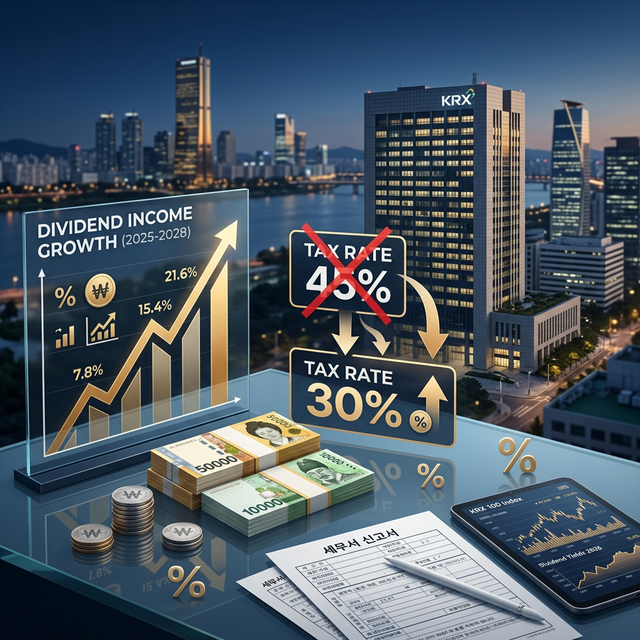
You received ₩50 million in dividends but paid ₩19 million in taxes? Here's what Korea's 2026 separate taxation reform means for you
You invested diligently and earned ₩50 million in annual dividends. Then the tax bill arrives: ₩19 million gone. That's a 38% tax rate. How does this happen?
In 2026, the Korean government introduced high-dividend separate taxation to address this problem (MBC News). This system can reduce dividend taxes from up to 45% down to 14-30%. But it's not beneficial for everyone. This guide covers everything from how the system works to how to determine if it's right for you.
The Old System: Why Were Dividend Taxes So High?
How Dividend Income Tax Worked
When you receive dividends, you pay tax. The problem is that the calculation method changes dramatically based on how much you earn.
Dividend Income + Interest Income = Financial Income
Financial Income ≤ ₩20M → 15.4% withholding tax, done (no filing needed)
Financial Income > ₩20M → Combined with other income → Comprehensive Income Tax (up to 45%)
The critical threshold is ₩20 million. Once you cross it, your dividends get combined with salary and business income, pushing you into much higher tax brackets.
Comprehensive Income Tax Brackets
| Taxable Income | Rate | Description |
|---|---|---|
| Up to ₩14M | 6% | Part-time / Low income |
| ₩14M - ₩50M | 15% | Average salaried worker |
| ₩50M - ₩88M | 24% | Mid-career professional |
| ₩88M - ₩150M | 35% | High-income employee |
| ₩150M - ₩300M | 38% | Executive / Specialist |
| ₩300M - ₩500M | 40% | Top earner |
| ₩500M - ₩1B | 42% | Ultra-high income |
| Over ₩1B | 45% | Maximum rate |
Simple Analogy: "Combined Report Card"
Imagine taking Korean and Math exams separately. Each score is average. But when both scores are combined to determine your ranking, you suddenly land in the top tier. Top tier means higher "penalties (= taxes)."
Dividend income works the same way. Your salary alone puts you at a 24% rate, but adding ₩50M in dividends pushes your total income up, and the rate jumps to 38%.
Example: ₩100M Salary + ₩50M Dividends (Old System)
- Employment Income
- ₩100M
- Dividend Income
- ₩50M
- Combined Income
- ₩150M
- Applied Tax Rate
- Up to 38%
- Est. Tax on Dividends
- About ₩19M
Key point: The dividends themselves aren't the problem. It's the combination with salary that pushes your rate way up.
Structural Problems with Comprehensive Taxation
It wasn't just about "high taxes." The existing comprehensive taxation system had fundamental structural flaws.
Problem 1: The ₩20M Threshold Frozen for 13 Years
The financial income comprehensive taxation threshold was originally ₩40 million. It was halved to ₩20M in 2013 and has been frozen for 13 years (Hankyung). Meanwhile, the market changed completely.
| Item | 2013 | 2025 | Change |
|---|---|---|---|
| KOSPI Total Dividends | ₩12.4T | ₩30.3T | 2.5x increase |
| Taxation Threshold | ₩20M | ₩20M | Frozen |
Total dividends grew 2.5x, but the threshold stayed the same. A limit that only "big wealthy" investors used to cross is now easily breached by ordinary investors.
Problem 2: Double Taxation, OECD's Highest Integrated Rate
Dividends are taxed twice (Sejung Ilbo). When a company earns profit, it pays corporate tax (up to 26.4%). When the remaining profit is distributed as dividends, shareholders pay income tax again (up to 49.5%).
Company earns ₩100
→ Pays ₩26.4 corporate tax → ₩73.6 distributed as dividends
→ Dividend income tax up to 49.5% → Shareholder receives about ₩37
₩100 earned, but only ₩37 reaches the shareholder (integrated rate ~63%)
OECD Integrated Dividend Tax Rate Comparison (KCCI Data)
- Korea
- 58.8% (Highest among 37 OECD nations)
- United States
- ~48%
- United Kingdom
- ~44%
- Japan
- ~50%
- OECD Average
- ~42%
According to the Korea Chamber of Commerce and Industry, Korea's integrated dividend tax rate is the highest among all 37 OECD countries. For the same profit, Korean shareholders take home the least.
Problem 3: Retirees Treated as "High Earners"
One in three comprehensive taxation targets earns less than ₩10M in employment income per year (News1). Most are retirees living on interest and dividends from their life savings. They aren't actually "high earners," but because their financial income exceeds ₩20M, they're treated as such.
Comprehensive Taxation Target Demographics
- Employment Income < ₩10M
- ~100,000 people (1/3 of total)
- Employment Income < ₩50M
- Over half of all targets
- Actual High Earners
- Fewer than expected
A retired grandparent living off interest and dividends from lifetime savings was paying the same tax rate as a ₩200M-per-year executive.
Problem 4: Health Insurance Premium Burden
When dividend income is subject to comprehensive taxation, it's also included in health insurance premium calculations (Changui Accounting). It's not just higher taxes; health insurance premiums go up too, creating a double burden.
Problem 5: A Driver of the Korea Discount
High dividend tax rates discourage Korean company major shareholders from paying dividends. More dividends mean more personal taxes. As a result, Korean companies' dividend payout ratios are among the lowest globally, and this is a core driver of the "Korea Discount" in stock valuations.
| Country | Average Payout Ratio |
|---|---|
| UK | ~60% |
| US | ~40% |
| Japan | ~35% |
| Korea | ~20-25% |
Summary: The problem with comprehensive taxation wasn't simply "high taxes." Frozen thresholds, double taxation, retiree impact, health insurance premium spikes, and the Korea Discount. All these issues were intertwined, which is why the government introduced the separate taxation system.
What Is High-Dividend Separate Taxation?
Core Principle: "Filing Separate Report Cards"
Previously, your salary report card and dividend report card were combined for ranking. Separate taxation means filing the dividend report card separately. When filed separately, each ranking drops, and taxes decrease.
Old: Salary + Dividends → Combined → Comprehensive Tax (up to 45%)
New: Salary → Comprehensive Tax (as before)
Dividends → Taxed Separately (14-30%)
Separate Taxation Rate Structure
| Dividend Income Bracket | Separate Rate | Including Local Tax | Old Comprehensive (High Earners) |
|---|---|---|---|
| Up to ₩20M | 14% | 15.4% | Up to 45% |
| ₩20M - ₩300M | 20% | 22% | Up to 45% |
| ₩300M - ₩5B | 25% | 27.5% | Up to 45% |
| Over ₩5B | 30% | 33% | Up to 45% |
Key: This 4-tier structure was finalized by the National Assembly Finance Committee in November 2025 (Toss Bank). The over-₩5B bracket was added, and the top rate was lowered from the original government proposal of 35% to 30%. Compared to the comprehensive tax maximum of 45%, it's still a significant benefit.
Another Analogy: "Buffet Pricing"
Previously, salary food and dividend food were placed on one plate and charged by total weight. The heavier the plate, the more you paid. Separate taxation means putting dividend food on a smaller separate plate with its own pricing. The smaller plate's price list is much cheaper.
Who Is Eligible?
To qualify for separate taxation, you must meet both investor requirements and company requirements.
Investor Requirements
Investor Requirements
- Eligible
- Korean residents with dividend income
- Applicable Dividends
- Dividends received after January 1, 2026
- How to Apply
- Submit separate application during income tax filing
- Automatic?
- No! You must apply yourself
Most important point: Separate taxation is not applied automatically. You must submit an application during your May comprehensive income tax filing (News1). The National Tax Service is working on improving HomeTax filing screens and developing a tax simulation calculator.
Company Requirements: What Is a "High-Dividend Company"?
Not all company dividends qualify. Only dividends from companies designated as high-dividend companies are eligible (Mirae Asset Securities).
High-Dividend Company Requirements (Meet Either)
- Condition A
- Dividend payout ratio 40% or higher
- Condition B
- Payout ratio 25%+ AND dividends up 10%+ vs. prior year
- How to Check
- Published on Korea Exchange KIND system
- Publication Date
- Day after AGM dividend resolution
What is dividend payout ratio? The percentage of net income a company distributes to shareholders. If a company earns ₩10B and pays ₩4B in dividends, the payout ratio is 40%.
What's Not Eligible
Excluded from Separate Taxation
- ETF Distributions
- Not eligible (all ETFs including high-dividend ones)
- Foreign Stocks
- Not eligible (US, Japan, etc.)
- REITs
- Not eligible
- Funds / Investment Companies / SPCs
- Not eligible
- Unlisted Companies
- Not eligible (KOSPI/KOSDAQ listed only)
- Stock Dividends
- Not eligible (cash dividends only)
Warning: Distributions from high-dividend ETFs (KODEX High Dividend, TIGER Dividend Growth, etc.) are not eligible for separate taxation (Nongmin Shinmun). Dividends from US stocks (Apple, Tesla, etc.) or foreign ETFs remain under existing comprehensive taxation. Only cash dividends qualify.
How Much Can You Actually Save?
Here are three case studies (Mirae Asset Securities). Separate taxation isn't always beneficial.
Case 1: High-Income Employee (Big Savings)
Case 1: ₩200M Salary + ₩50M Dividends
- Employment Income
- ₩200M
- Dividend Income
- ₩50M
- Old Comprehensive Rate on Dividends
- 38-40%
- Old Dividend Tax
- ~₩19M
- Separate Taxation Rate
- 14-20%
- Separate Taxation Tax
- ~₩10M
- Tax Savings
- ~₩9M
Case 2: Mid-Income Employee (Moderate Savings)
Case 2: ₩50M Salary + ₩30M Dividends
- Employment Income
- ₩50M
- Dividend Income
- ₩30M
- Old Comprehensive Rate on Dividends
- 24-35%
- Old Dividend Tax
- ~₩8.4M
- Separate Taxation Rate
- 14-20%
- Separate Taxation Tax
- ~₩4.8M
- Tax Savings
- ~₩3.6M
Case 3: Low-Income Earner (Comprehensive Tax Is Better!)
Case 3: ₩20M Salary + ₩15M Dividends
- Employment Income
- ₩20M
- Dividend Income
- ₩15M
- Comprehensive Tax Rate
- 6-15%
- Separate Taxation Rate
- 14%
- Conclusion
- Comprehensive taxation is better or equal!
Why? If your income is low, your comprehensive tax rate is already 6-15%. This can be equal to or lower than the 14% separate taxation minimum, so there's no reason to apply for separate taxation.
Decision Guide by Salary Level
| Salary | Dividend Income | Comprehensive Rate | Separate Rate | Better Choice |
|---|---|---|---|---|
| ₩20M | ₩15M | 6-15% | 14% | Comprehensive |
| ₩30M | ₩25M | 15% | 14% | Similar (Separate slightly better) |
| ₩50M | ₩30M | 24-35% | 14-20% | Separate |
| ₩80M | ₩40M | 35% | 14-20% | Separate |
| ₩100M | ₩50M | 35-38% | 14-20% | Separate |
| ₩200M | ₩100M | 38-40% | 14-20% | Separate |
Quick rule: If your comprehensive income tax rate is 24% or higher, separate taxation is almost certainly beneficial.
How to Apply and Timeline
Application Checklist
| Step | Action | When |
|---|---|---|
| 1 | Check if your invested companies qualify as high-dividend on KIND | After AGM dividend resolution |
| 2 | Determine your comprehensive income tax rate (is separate taxation beneficial?) | Anytime during the year |
| 3 | Use HomeTax simulation calculator to compare tax savings | Before filing |
| 4 | Submit separate taxation application during income tax filing | Every May |
Which Stocks Are Getting Attention?
The introduction of high-dividend separate taxation makes companies with generous dividends more attractive to investors. Here are the sectors and representative stocks gaining attention.
| Sector | Representative Stocks | Dividend Characteristics |
|---|---|---|
| Finance | KB Financial, Shinhan, Hana Financial | High payout ratios, stable earnings |
| Insurance | Samsung Fire & Marine, DB Insurance, Hyundai Marine | Consistent high-dividend tradition |
| Shipbuilding | HD Korea Shipbuilding | Improving earnings + rising dividends |
| Telecom | KT, SK Telecom | Stable cash flows, high dividends |
| Energy | S-Oil, GS | High dividend yields |
What About Dividend ETFs? Not Eligible
This is a common question. High-dividend ETF distributions are not eligible for separate taxation. The enforcement decree explicitly excludes them.
Why ETFs and REITs Are Excluded
- ETFs / Funds
- They redistribute received dividends to customers → Excluded
- REITs
- Excluded for consistency with fund treatment
- What Qualifies
- Only cash dividends from individual listed high-dividend companies
This means distributions from KODEX High Dividend ETF or TIGER Dividend Growth ETF are not eligible. To benefit from separate taxation, you must directly hold individual shares of qualifying high-dividend companies.
If your dividend income is under ₩20M? ISA tax-free benefits + pension account tax deferral offer better tax savings than separate taxation. Separate taxation is meaningful for investors whose financial income exceeds ₩20M.
Controversies and Limitations
There are criticisms and limitations of this system.
System Limitations
- Equity Concerns
- Benefits concentrated among high-income earners
- Limited Scope
- Only domestic listed high-dividend companies (foreign stocks excluded)
- Temporary
- 3-year program for 2026-2028 dividends (extension uncertain)
- Application Burden
- Not automatic; annual application required
- Changing Eligibility
- High-dividend company designation may change yearly
In November 2025, the National Assembly Finance Committee finalized the top rate at 30% (down from the original 35% government proposal) and added the over-₩5B bracket (Toss Bank). Discussions continue about expanding the scope beyond just high-dividend companies.
Conclusion: The 3-Second Decision Method
Your comprehensive tax rate ≥ 24% → Separate taxation almost certainly better
Your comprehensive tax rate 15-24% → Depends on dividend amount (use simulator)
Your comprehensive tax rate ≤ 15% → Comprehensive taxation likely better
The system looks complicated, but the core is simple. "If your tax rate is high and you receive large dividends, apply." When May 2027 comprehensive income tax filing arrives, use the HomeTax simulator, and apply if it's beneficial.
This article is based on information publicly available as of March 2026. Tax rates and eligibility conditions may change through legislative processes. Please verify final details on the National Tax Service HomeTax website. Investment decisions are your own responsibility, and for specific tax advice, consult a certified tax accountant.